Revealing 4K Repair: Is the Old Movie Blurred for Face Change or Beauty?
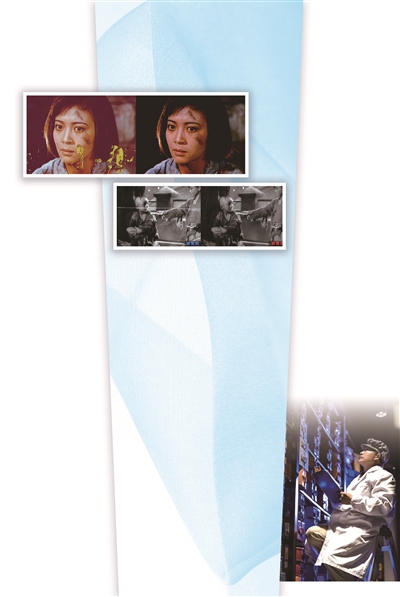
Comparison of Pictures before and after the Restoration of Song of Youth; Comparison of Pictures before and after the Restoration of San Mao’s Wandering Story Film Movie Warehouse
Photo courtesy of this edition: Huaxia Film Movie
A film "founding ceremony" brought the proper term "4K repair" into readers’ sight. How have the old films been preserved to the present, and how have they revealed their new features through 4K restoration technology? Recently, Yangzi Evening News/Zi Niu news reporter contacted Chen Xinxin, general manager of Jiangsu Huaxia Film Restoration Technology Co., Ltd. in Rugao, to deeply analyze the "old craftsmanship" of film physical restoration and the high technology of digital restoration.
Yangzi Evening News/Zi Niu News reporter Liu Liyuan
Why repair?
Digital means of collecting documentaries of Yangtze River Bridge to spread precious images
The Yangzi Evening News reporter learned in the interview that there are not many domestic institutions that have mastered the film restoration technology at present, but in Jiangsu, the number and scale of Huaxia film films in the old film-related collections, the technical strength and technical ability of the film restoration team are in a leading position, and there are only a handful in the country; In addition, Huaxia Film Film is the only company in China that has expanded the full range of digital restoration business in audio-visual archives.
At present, Huaxia Film Film has collected more than 20,000 film materials, and digitally restored a large number of excellent film films and documentaries, including furong town, a masterpiece directed by Xie Jin, and Ruan Lingyu, a precious documentary about Ruan Lingyu’s life.
Chen Xinxin told reporters that while carrying out digital restoration, the preservation of film movies is also their very important work. "We have invested a lot of energy in environmental management such as constant temperature and humidity, as well as digital storage management. In fact, as long as the method is reasonable, film movies can keep clear pictures for a long time."
"Film movies, especially documentaries, have left real images of the past and are very precious historical materials." Chen Xinxin said that Huaxia Film Film has collected a large number of regional documentaries with local characteristics, such as the opening of Nanjing Yangtze River Bridge and the development of Suzhou silk industry. Two documentaries, Nanjing Yangtze River Bridge and Construction Technology of Nanjing Yangtze River Bridge, were filmed by the Central News Recording Film Studio in the 1960s. Huaxia Film Film began digital restoration of these two documentaries last year, and now the restoration work has been completed. Chen Xinxin said that due to copyright reasons, these two documentaries are not currently online on the video platform. Next month, the private archives of Huaxia Film Film Film Construction — — Jiangsu Film Archives Exhibition Hall is officially opened. At that time, citizens can watch these two documentaries and consult other documentaries and information pieces.
How is the wonderful rejuvenation done?
Are you still using the "old craft" to repair the film?
New technology "blessing", cleaning method is similar to tooth washing.
Chen Xinxin told reporters that the restoration of old movies is mainly divided into three stages: physical restoration, digital scanning and digital restoration.
"Physical repair is the most basic link. The more effort you spend in the physical repair stage, the less pressure you will have in the following process." Chen Xinxin said that physical repair is to repair the film itself with equipment or manpower. For example, the film is oily or dusty, and it is broken because of excessive dryness and stuck together because of excessive humidity.
The physical restoration of film is an "old craft" similar to the restoration of cultural relics. However, the technological content of this process is getting higher and higher. Chen Xinxin, for example, the conventional film cleaning still stays in the manual stage, wiping the dust with water or solvent, while Huaxia Film Film Film introduced a series of cleaning equipment, the principle of which is similar to that of tooth cleaning, using ultrasonic method to shake off oil and dust. Compared with manual dust removal, the cleanliness of ultrasonic dust removal can be improved by more than one time. The polishing equipment of films is equally powerful: some films have deep scratches, and after "polishing" by the polishing equipment, the scratches can be smoothed without damaging the picture.
What about the badly damaged picture?
What is completely unclear can only be guessed, and it is necessary to "repair the old as the old"
In the first half of this year, Huaxia Film Co., Ltd. and Iqiyi Film Co., Ltd. jointly restored the old film "San Mao Wandering". The black-and-white film, which started shooting in 1948, was badly worn, and it took more than 20 members of Huaxia Film Film Team two and a half months to complete the 4K restoration work. In June, the restored film appeared in the 22nd Shanghai International Film Festival "Memory of Light and Shadow, Classic of the Times: Special Film Festival for the 70th Anniversary of the Founding of New China".
Chen Xinxin said that after physical restoration, the film was scanned into digital format with professional instruments and equipment, and then it entered the digital restoration stage, which mainly used professional software to remove the content that should not exist. The process sounds simple, in fact, the content of software repair needs manual comparison. A movie usually has hundreds of thousands of frames, and each frame has to be compared twice by human eyes.
Some pictures in San Mao’s Wandering Tale are seriously damaged. For some pictures whose faces and movements are unclear, the staff can only combine the previous frame and the next frame with the recognition function of the repair software to "make" the original damaged pictures and make them complete. In order to ensure that the restoration can be true and restored, there are usually professional film review staff in the process of film restoration to ensure that the picture and sound of the film are not much different from the original film.
Is the old movie "born" ambiguous?
With the help of 4k technology, the clarity is "found" back.
Both San Mao’s Wandering Tale and the upcoming founding ceremony have been restored in 4K. "The so-called 4K means that the resolution is 4096×2160."
In many people’s impressions, old movies mean blurred pictures, but Chen Xinxin told reporters that film movies are physical imaging, and their own resolution can reach 6.5K, which is higher than the current ordinary 2K digital movies. Some films shot with 70mm film can even reach 8K resolution.
Most people’s impression of old movies comes from the video tapes converted in the 1980s and 1990s. At that time, due to the technical limitations, the converted pictures can only achieve the effect of quasi-standard definition (lower than the resolution of 1280×720), and the projection effect on TV will be almost poor. Digitally restored old movies can generally reach the resolution of 2K, and with the gradual maturity of 4K technology, more old movies are directly converted into clearer 4K versions, and TVs, mobile terminals and cinemas can access materials as needed.
Feelings are not old
Those "stubborn" directors should use the film texture to keep the details.
Nowadays, mainstream cinemas are showing digital movies. "The main reason why digital movies are gradually replacing film movies is cost." Chen Xinxin said that the film was "scrapped" after being used once. If the actor NG, shooting again and again is "burning money" again and again, and it costs money to finish developing the film. As long as you buy a good digital camera, you can shoot indefinitely.
However, there are still a group of directors at home and abroad who "stubbornly" shoot films with film and pursue "film texture". For example, Nie Yinniang the Assassin directed by Hou Xiaoxian and Inception directed by Christopher Nolan are excellent films. "Film movies are physical imaging, not piled up by pixels. Compared with digital movies, they are more realistic, more restored and have stronger contrast, and more picture details and colors are preserved."
The future is not old.
From frame 24 to frame 120, Ang Lee returned with "ambition"
Next month, the new film "Gemini Man" directed by Ang Lee will be released, which is Ang Lee’s second film with a 120-frame version.
In 2016, director Ang Lee completed his first 120-frame film "Billy Lynn’s Long Halftime Walk", which made some audiences experience the ultimate movie-watching experience in 120-frame, 4K and 3D versions for the first time.
Chen Xinxin introduced that ordinary movies and TV plays 24 or 25 frames per second. According to the visual retention characteristics of human eyes, 24 frames per second can ensure that we can’t see the action interval. However, if we pause the video during the action picture, we will find that the picture from shot A to shot B is "pasted", which is because there are too few frames to capture a certain point. The more frames of video per second, the more details there are, and the fluency of video will be greatly improved. Coupled with the clear picture of 4K camera, 4K and 120-frame movies can provide viewers with a subversive viewing experience.