BYD Equation is controversial. Who does the driving data belong to?

An official statement issued by BYD Equation Leopard brand recently unexpectedly triggered a discussion on automobile data security.

On December 2nd, Equation Leopard responded to the "Equation Leopard’s 500km fuel consumption reached 18L" measured by an online blogger. Equation Leopard said in the statement that the blogger’s test at high speed involved speeding. Equation Leopard retrieved the relevant vehicle operation data at the request of the police and found that there were a lot of abnormal driving behaviors on the vehicle that day. Equation Bao explained the blogger’s abnormal driving situation in words and attached the original driving data map to the statement.

Equation Leopard is BYD’s personalized off-road brand, and Leopard 5 is the first product. The above statement of Equation Leopard is to show that the fuel consumption measured by bloggers is inaccurate through the announcement of abnormal driving conditions. However, this statement quickly triggered a discussion on the ownership of driving data in the industry. Some viewpoints point out that Equation Leopard made the driving data public before the police came to a conclusion, which was suspected of infringing on the driver’s privacy.

In fact, the discussion on data security and data privacy triggered by Equation Leopard is not the first time in the industry. When an automobile accident happens, companies have different ways to retrieve and publish data. There are examples where the owner’s driving data is released at the first time, like Equation Leopard, and there are also examples where the owner is accused of not providing the data for a long time, like Tesla.

Who does the user’s driving data belong to and how should it be used correctly?Behind the controversy caused by the equation leopard, it once again points to these focus issues.

1. Does Equation Leopard infringe the rights and interests of car owners?

Is the disclosure of the owner’s driving data in the official statement of Equation Leopard suspected of infringing the owner’s rights and interests? There are two main controversies about this issue.

First, it is necessary to determine whether the driving data belongs to the privacy or personal information of the user.Lu Wenliang, a special researcher in the automotive industry of the Industrial Science and Technology Innovation Center of the Strategic Consulting Institute of China Academy of Sciences, said that according to the Personal Information Protection Law, the driving data of the owner disclosed in the statement by Equation Leopard, including the time node and the driving speed, belong to the owner’s personal information, and in principle Equation Leopard should be kept confidential.

Some legal stakeholders also said that the personal information protected in the Personal Information Protection Law is divided into sensitive information and general information. Vehicle speed information is not sensitive information, but general information, which is not strictly confidential.

Another point of view is that Equation Leopard did not disclose the full name of the owner in the statement, but hid the middle field, which belongs to anonymous processing, so it is not included in the protected personal information. “(Data published by Equation Leopard)Driving data belonging to the background of the system, stored and produced in the background of car companies, are difficult to be completely defined as personal matters, and involve public safety, so it is difficult to apply to the protection of privacy or personal information rights. Wu Xindong, a deheng law offices lawyer, said.

Another controversial point is whether Equation Leopard has the right to announce users’ driving information before the police.Lu Wenliang said that from the statement of Equation Leopard, it indicated that the data was retrieved at the request of the police. According to the procedures for handling road traffic safety violations of the public security department, the public security department can require enterprises to provide corresponding evidence based on the need of investigating administrative violations. Equation Leopard is legal and compliant if it collects driving data and provides it to the law enforcement department of the case investigation. However, there is no clear support for whether it can be announced before obtaining the consent of the owner.

There are other views that car companies also have the right to disclose personal information because the dangerous driving behavior of the owner has threatened public safety. It is understood that some car companies and brands will unilaterally issue "privacy clauses", stipulating that personal information of car owners can be unconditionally released under special circumstances.

For example, the Privacy Clause issued by Great Wall Motor official website shows that it is directly related to national security and national defense security; Directly related to public safety, public health and major public interests; As well as directly related to judicial or administrative law enforcement such as criminal investigation, prosecution, trial and judgment execution, the sharing and public disclosure of personal information do not require authorization.

In addition, as a reference, this year, some car companies have announced the driving information of vehicles for accidents.For example, Tesla collided with 11 cars and the tank responded to the owner’s claim. In both cases, the car companies announced the owner’s driving information. However, a careful comparison shows that the statements of Tesla and Tanks are still different from those of Equation Leopard. Tesla and Tanks only described the driving information of vehicles in words, but did not publish the original background data of vehicles, while Equation Leopard published the original background data.

Second, car data privacy issues to be solved

Who does the driving data belong to? Who should retrieve and publish it? This is the core of all the arguments. According to the current relevant laws and regulations, when collecting personal information such as driving data, it must be approved by the owner, so it is generally considered that the owner is the owner of the data. However, the paradox is that when a vehicle has an accident, because the owner does not have professional technical means and equipment to retrieve the data, it can usually only be obtained through the car company. If the information between the user and the car company is opaque, there will be data disputes between the car company and the user.

The "roof rights protection" of Tesla owners is a typical data dispute case in the automobile industry in recent years.In this case, the car owner accused the car company of infringing personal privacy information, and at the same time, the car company also paid attention to whether the information disclosed by the car owner was sufficient.

At the Shanghai Auto Show in 2021, Ms. Zhang complained that Tesla’s brakes failed, and then Tesla provided the reporter of China Market Supervision with the data one minute before the vehicle accident and issued a written explanation. The data includes information such as the frame number, driving speed and when to brake of the vehicle involved. After the publication of this information, Ms. Zhang believed that Tesla made the driving data public and was suspected of infringing on her personal privacy, so she filed a lawsuit.

In the end, the court did not support Ms. Zhang’s claim, arguing that the data provided by Tesla could not be related to the owner’s personal private information. The relevant civil judgment shows that Tesla Company responded to Ms. Zhang’s query, and provided the vehicle data one minute before the vehicle accident, including the frame number, with a text description to the market supervision newspaper. The market supervision newspaper did not delete it or make subjective comments to publish it. From the content of this set of data and text description, it only described and explained the relevant data and could not be related to Zhang’s personal private information.

The content of Tesla’s complaint mentioned above is similar to the move of Equation Leopard to directly announce the owner’s driving information. However, there are differences between the two at the operational level. Tesla provided the data to the media at that time and released it by a third party. Equation Leopard directly released the background data through an official statement.

In the Tesla case, Ms. Zhang also accused Tesla of not disclosing enough information. Ms. Zhang pointed out that there are only 11 items of data provided by Tesla, among which there are many parameters of the braking system, such as the speed of motor torque, the data of kinetic energy recovery, and the stroke of the brake pedal. These data are the key to identify whether Tesla’s brakes are sensitive, but Tesla did not provide them. Ms. Zhang asked Tesla to provide a complete driving record 30 minutes before the incident, but it was never successful. The case is still on appeal.

Regarding driving data, "excessive disclosure" and "incomplete disclosure" will both cause controversy.The lack of specific provisions in laws and regulations is an important reason for this situation.

At present, in addition to the data security law, personal information protection law and other superior laws, the main document on data protection in the automobile industry is several provisions on automobile data security management.(Trial)(abbreviation: "Regulations"). The Regulations were jointly issued by the National Internet Information Office, the National Development and Reform Commission, the Ministry of Industry and Information Technology, the Ministry of Public Security and the Ministry of Transport, and came into effect on October 1, 2021.

The "Regulations" require that car owners can consult or copy their personal information from car manufacturers according to law, and car companies are obliged to ask users before collecting their personal information, and collect it after obtaining the permission of users. And the state has the right to spot-check the implementation of relevant work of various car companies.

Lu Wenliang pointed out that due to the early formulation and the lack of rich data disputes as a reference, some provisions of the Regulations on driving data are relatively rough, and whether car companies are suspected of infringing on personal information rights and interests may depend on the judge’s own ruling.

At present, with the development of smart cars, there are more and more records of users’ driving data, which not only provides convenience for after-sales service, but also brings higher challenges to users’ privacy protection. Many users have noticed and initiated complaints about the problems such as the camera in the car recording the driver’s behavior and the third-party map software leaking the user’s driving trajectory.In order for smart cars to be truly accepted by users, it is imperative to solve the problem of data ownership and privacy security.

This article comes from WeChat WeChat official account:Economic observer (id: eeo-com-cn), author: Zhou Ju

Beijing CDC recommends # 7 to 14 days before purchasing overseas mail-order items.

Today (April 7) afternoon, Beijing held a press conference on epidemic prevention and control to introduce the epidemic situation and the latest progress in epidemic prevention. A reporter at the scene asked, this round of epidemic has caused infection by overseas mail-order items. How do citizens dispose of the purchased overseas mail-order items? In this regard, Pang Xinghuo, deputy director of the Beijing Center for Disease Control and Prevention and a member of the national novel coronavirus expert group, said that there have been reports of Covid-19 nucleic acid positive in overseas mail, clothes and other articles in many places in China recently. Pang Xinghuo specially reminded the general public and friends that it is not necessary to buy less Haitao during the high-incidence period of foreign epidemics, and be careful to mail-order goods from countries and regions with high-incidence epidemics. If you have purchased goods that are not urgently needed, it is recommended to put them at room temperature for 7-14 days before processing.

Pang Xinghuo said that when receiving overseas mail or articles, you should wear masks and disposable gloves correctly, reduce direct contact, pick up the pieces at a fixed place as much as possible, and realize contactless handover. If you need to sign in person, please keep a safe distance; Dismantle the parts outdoors as far as possible, and go home without outer packaging, and treat them according to the classification of domestic garbage. If you need to take them home, you can spray or wipe the surface of mail and express delivery with chlorine-containing disinfectant or 75% alcohol to ensure that each side is completely wet, ensure all-round disinfection, and at the same time do a good job in disinfection of unpacking and transshipment tools; Mail-order items can be disinfected by disinfectants and thermal disinfection, or stored for a period of time before use; After handling mail and express delivery, you should take off gloves in time, change masks, carefully clean your hands or disinfect them, and avoid touching your mouth, eyes and nose with unclean hands.

Are moon cakes "cakes" or "cakes"? The new standard has been determined! And these ingredients can’t be used →

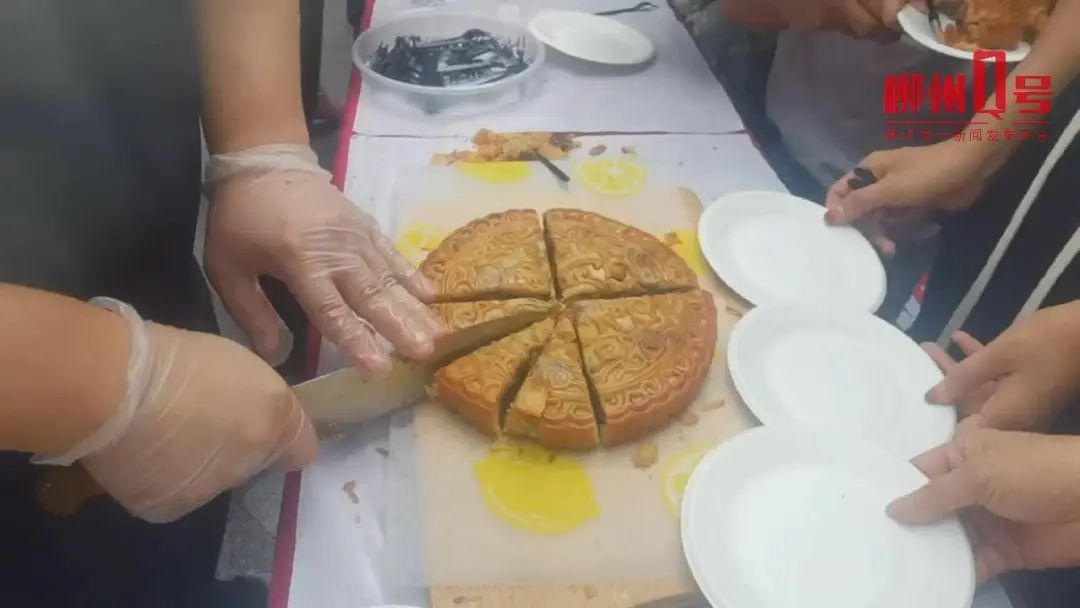
On July 8, the reporter learned from the Municipal Market Supervision Bureau that the city’s market supervision system, together with the leaders of mooncake production enterprises, large supermarkets and hotels operating mooncakes, participated in the training meeting on the publicity and implementation of the new edition of the General Rules for the Quality of Mooncakes, further deepening the understanding and cognition of the mooncake industry on the new standards, helping enterprises to understand and master the technical contents of the new standards in time, and providing support and guarantee for the healthy development of the mooncake industry.

source map

According to the announcement issued by the State Administration of Market Supervision, the new version of the revised "General Rules for the Quality of Mooncakes" has been officially implemented, and the old version of the "Mooncakes" revised in 2015 has been abolished. At the publicity and implementation training meeting, experts from the Municipal Quality Inspection Center interpreted the new version of the General Rules for the Quality of Mooncakes and the standards for restricting the over-packaging of commodities requiring food and cosmetics. By comparing the new and old standards and giving examples, they explained the background, terminology definition, main content requirements, enterprise implementation standard rules and matters needing attention of the standards in detail, and answered questions raised by enterprises about label identification and mooncake naming.

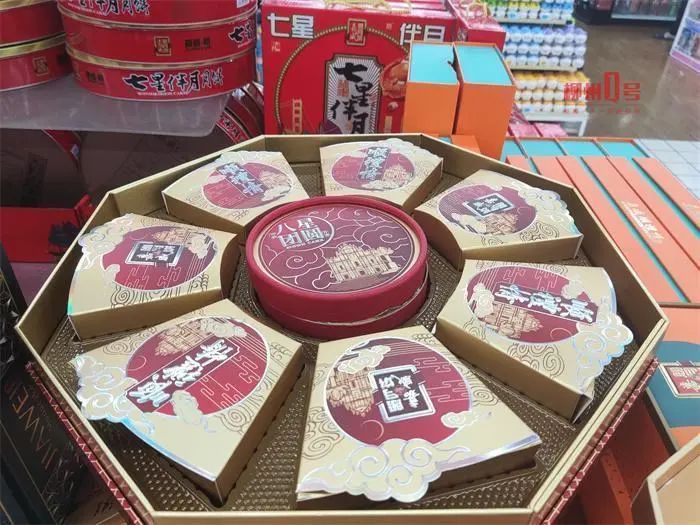
The mooncake gift box in the supermarket. (data map)

Compared with the old and new editions, there are many new changes worthy of attention. According to experts from the Municipal Quality Inspection Center, the new version of the standard changes the name from "Moon Cake" to "General Rules for the Quality of Moon Cake", refines the specific categories of raw materials, deletes the word "main" in the main raw materials, standardizes the name format of edible oils and fats, and divides sugar into the main raw materials of cake crust, and clearly points out that moon cakes are cakes.

In addition, the new version of the standard changes the product classification into three categories: classification by processing technology, classification by local characteristics and other kinds of moon cakes, and deletes the hot processing category and cold processing category, and divides moon cakes into baking category, frying category, cooking category and cooked flour category, and cancels other categories under the cold processing category. According to the new standard, moon cakes are divided into 9 categories: Cantonese-style moon cakes, Beijing-style moon cakes, Soviet-style moon cakes, Chaozhou-style moon cakes, Yunnan-style moon cakes, Jin-style moon cakes, Qiong-style moon cakes, desktop moon cakes and Harbin-style moon cakes. The definition of the sub-classification of moon cakes with local characteristics has been deleted.

At the same time, the new version of the standard has added requirements for cake crust and stuffing, clearly stating that moon cake stuffing should not use wild protected animal ingredients such as shark’s fin, and should not use rare and precious ingredients such as bird’s nest. The new standard stipulates the types of cake crust and stuffing, and divides the cake crust into: syrup crust, crispy crust, mixed crispy crust, egg moon baked (cake) crust, crystal crust, ice crust, milk crispy crust, cream crust and peach mountain crust. The fillings are divided into: rongsha stuffing, nut stuffing, fruit and vegetable stuffing, egg yolk stuffing, meat and meat products stuffing, aquatic products and aquatic products stuffing, attention stuffing (soft-hearted stuffing), natural white stuffing, natural red stuffing, cloud leg stuffing and edible flower stuffing. In different fillings, the requirements for the addition amount of related raw materials are stipulated, and the naming of product names is required according to the addition amount of fillings.

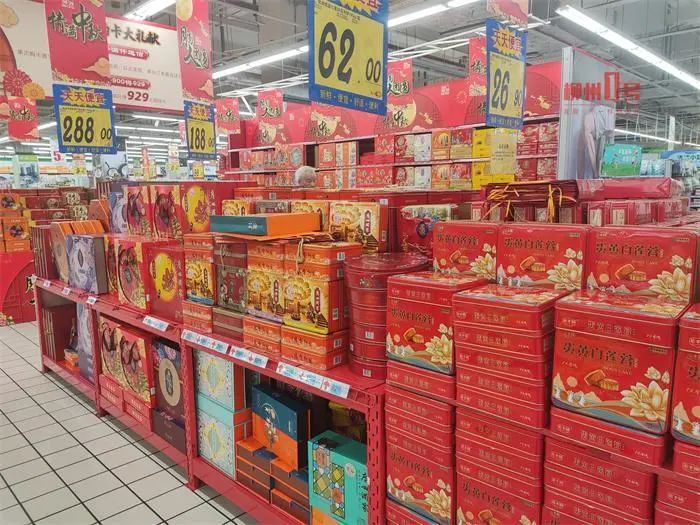
Moon cakes are neatly placed on the supermarket shelves. (data map)

In terms of inspection rules, the new version of the standard has also been revised. The ex-factory inspection items of the new standard include but are not limited to sensory requirements, moisture content, net content and stuffing content. Compared with the old standard, the mandatory inspection requirements for the total number of colonies and coliforms are deleted, and the new mandatory inspection item is moisture. The new version of the standard also deletes the seasonal production and perennial production type inspection, and changes it to the type inspection of products once a year. In addition, the new version of the standard clearly requires that if the factory inspection and type inspection are unqualified, double sampling and re-inspection can be carried out in the original batch of products.

The new version of the standard also adds the naming method of moon cake products, stipulating that the local pie moon cake should be clearly named in the local pie style and the characteristics of the cake crust or stuffing, and the product category can be built separately or reflected in the product name, such as Cantonese pure white lotus seed cake. Other moon cakes can be named with cake skin or stuffing, such as crystal skin pineapple moon cakes; Or choose to be named after the flavor characteristics of the product, such as espresso moon cakes.

The staff of the Municipal Market Supervision Bureau introduced that the "Restricting the Overpackaging of Commodities and Requiring Food and Cosmetics" explained at the training meeting was implemented last year, which put forward specific requirements for restricting the over-packaging of moon cakes. During the transition period of updating the old and new standards, according to the relevant documents, the service life of the old packaging materials for moon cakes can be extended to October 1 this year (subject to the production date).

After the transition period, the packaging of moon cakes should meet the new regulations, that is, the number of packaging layers should not exceed three; For moon cakes with a sales price above 100 yuan, the cost of all packages except those that are in direct contact with the contents shall not exceed 15% of the sales price of the products; Precious metals and mahogany materials should not be used; Not mixed with other products; The packaging void ratio meets the standard requirements.

Recommendation of "Liuzhou Evening News Optimization"

Liucheng Fengshan Huang Zhiying Yunpian Cake

Traditional handmade soft glutinous rice is sweet and fresh.

39 yuan /5 boxes

65 yuan /10 boxes

Original title: "Is the moon cake a" cake "or a" pastry "? The new standard has been determined! And these ingredients cannot be used → "

Read the original text

About screening for diseases during pregnancy


For all diseases, whether pregnant or non-pregnant, the first strategies recommended by doctors are: early prediction, early detection, early prevention and early intervention. This is a common practice in health management, health promotion, disease prevention and disease control.

This unisex practice in Xian Yi, old and young, is best implemented in obstetrics, which is universal.Pregnancy check-up mode.

The mode of prenatal check-up during pregnancy originated in Britain. As early as 1929, the British Ministry of Health issued a memorandum recommending pregnant women to have regular prenatal check-ups. This systematic management mode of prenatal check-up was quickly accepted and popularized all over the world.

In the last century, this measure made a great contribution to the remarkable reduction of maternal mortality and perinatal mortality rate all over the world.

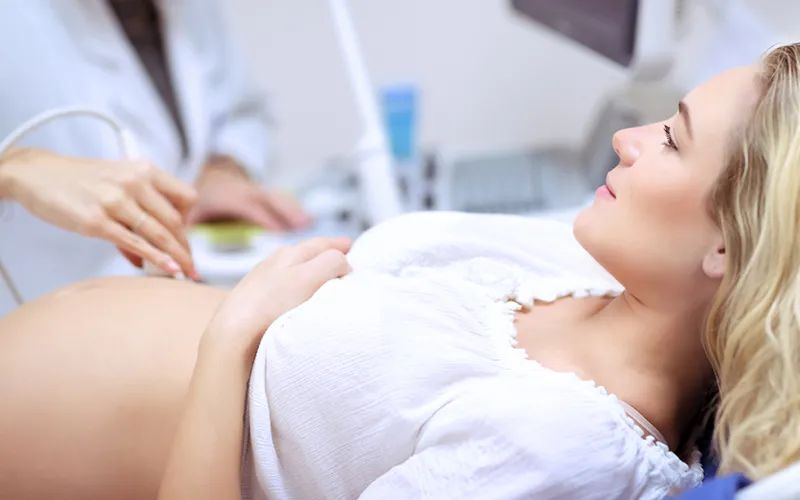
The main purpose of prenatal examination is screening for diseases during pregnancy.For those relatively common diseases that may have adverse effects on mothers and fetuses, screening is conducted in order to find risks, make early prediction, early prevention and intervention.

Screening for diseases during pregnancy is aimed at normal people.It is all pregnant women, not a few, who want to screen out people with problems in the normal population.

So don’t always question why everything is normal when you are pregnant. The doctor still has to prescribe all kinds of laboratory tests for you. You should be happy to find out that there is no problem. Don’t think it’s a waste of money. Do you want every penny to be spent, and every laboratory test can find out the problem?


(Source: Giphy)

If it is a high-risk population, screening is generally not needed, and diagnostic examination can be carried out directly.

Compared with screening, diagnostic examination methods are usually more complicated, more expensive and more likely to be invasive.

As for which diseases need screening, which diseases don’t need screening and which screening method to use, it needs comprehensive consideration.

Screening needs to balance screening efficiency, sensitivity, specificity, cost-benefit analysis, how much money to spend and how many people to screen before a patient can be diagnosed.

Therefore, you will see that different countries and regions will have different recommendations for the check-up items during the whole pregnancy. Some check-up items are more, while others are less, which is mainly a cost-effective choice.

The prenatal check-up during pregnancy is a model and pioneer of systematic and comprehensive disease screening for the whole population in the history of modern medicine. Many non-pregnant people learn the strategies of disease screening from the prenatal check-up.

At present, during the check-up, the commonly used screening for diseases during pregnancy includes:down syndrome screening,B-ultrasound screening for macromalformation,Preeclampsia screening,Premature birth screening,screening for gestational diabetes mellitus,Thyroid disease screening,Screening for sexually transmitted diseases,GBS screeningWait, I will take the most common Down’s screening as an example to make an introduction for everyone.

In the whole population, the incidence of Down syndrome is about 1/800-1,000. In order to improve the efficiency and reduce the risk, we usually adopt the combination of screening and invasive diagnosis.

That is to say,For a high-risk minorityWe do invasive amniocentesis and karyotype analysis directly.

For normal peopleFirst, we screen the mother’s peripheral blood. For pregnant women with high risk of screening, we do invasive amniocentesis and karyotype analysis.

There are two main screening methods now, one is the traditional and classic screening of maternal peripheral blood biochemical indicators, which is also called ".down syndrome screening",and the other is advanced screening, that is, non-invasive examination of fetal free DNA in maternal peripheral blood, also referred to as".noninvasive”。

Compared with the traditional "Down’s screening", the price of "non-invasive" will be higher, but the detection rate of Down’s syndrome will be higher, and the false positive rate and false negative rate will be lower, which can reduce more unnecessary amniocentesis.

The results of traditional "Down’s screening" will be divided into three categories: high, medium and low risk, or high and low risk. The cut-off value of high risk is usually set at 1/250, and the high risk will be recommended for amniocentesis.

Therefore, if you want to do screening, you need to know a lot of terms related to screening and the meaning behind these terms.

The following terms and meanings are related to Down’s Screening:

Background risk:The probability and risk of Down’s syndrome in the normal population is about 1/800-1,000.

Screening risks:When you do "Down’s Screening", the risk value may be low risk or high risk.

Residual risk:Even if the result of Down’s screening is low risk, it doesn’t mean that everything is fine, and there is still a relatively low risk, which is the so-called residual risk.

Invasive diagnostic risk:If it is a high risk, you will be advised to do amniocentesis. The risk of abortion caused by amniocentesis is about 1-2/1000, which is the additional risk brought by invasive diagnosis itself.

Game theory game theory:Doing "Down’s Screening" is actually betting on probability, that is, making a choice between the above probabilities and making a choice.

In the normal population, the incidence of Down syndrome is about 1/800-1,000. You can choose to do "Down screening" or not.

Some people think that this probability is very low, so they decide not to do it, but what if they win the prize?


(Source: Giphy)

If the result of "Down’s Screening" is that the risk is 1 in 200, the doctor suggests that you do amniocentesis, and the probability of miscarriage is 1-2 in 1,000, do you do it or not?

Which risk are you more afraid of?

Screening or not screening? Do you need an invasive diagnosis? This is betting on probability.

The correct and reasonable choice principle is to look at the high probability, and to consider the balance between income and risk. It is not only the probability that you gamble, but also whether you are willing and able to accept the consequences of gambling loss.

Gamble if you can afford to lose, even if the risk of 1/100 is not high. If you can’t afford to lose, don’t gamble, even if the risk of 1/1000 is too high, you have to be willing to gamble and lose.

With the continuous progress of technology, more and more diseases can be screened. Even for the same disease, more and more screening methods can be selected, and the screening methods are becoming more and more accurate.

Of course, you are facing more and more choices. Are you ready, students who love to struggle?

The commander of the Israeli navy is of China descent and has achieved extraordinary things.


  Israel’s new naval commander, Eli Marom


  The "first" in the army


  At the end of October, Israel’s new naval commander, Aili Maroum, officially took office. Unlike his predecessor, as well as officers of all arms such as the Israeli navy, Ali has a distinctive China silhouette, and his face, skin color and hair are quite "China-like", so that he looks like a China at first glance. It turns out that Ellie is of China descent. It is the first time in Israeli history that a person of China descent holds such a high military post.


  On October 8th, Ali Maroum was officially appointed. On the same day, Israeli Defense Minister Barak, Israeli Chief of Staff Askin Naz and others held an appointment ceremony for him. Barak admired Ali and had high hopes, because he was interested in David, the former naval commander. Ben? Basat’s performance in the Israel-Lebanon war was "extremely dissatisfied", and he always wanted to "take off" the admiral who had worked for four years, but he was constrained by the relations between all parties and did not do it easily. This time, Barak finally made a decision. He patted Ali on the shoulder and said, "Work hard, make up for the losses caused before, and rebuild the elegance and glory of the Israeli navy." Askin Naz also encouraged Ali: "It’s up to you now!"


  "Alternative" makes extraordinary achievements.


  The 52-year-old Aili’s grandfather is a native of China, and her grandmother moved to China from Russia. Aili’s father fled from Germany to China in World War II, met Aili’s mother and got married. Seven years after the establishment of Israel, the couple returned to Israel to settle down, and Ali was born here.


  Because Ellie’s oriental characteristics are obvious, she has been called "Chinese" since she was a child. This nickname comes from the English word "Chinese" (from China). From the time he was sensible, Ali realized that his appearance was "different", but he didn’t resent being called "Chiney". Even when introducing himself to strangers, he took the initiative to say "My name is Chiney". According to Ali’s classmates, he was always at the top of his class and had a strong personality. After joining the army, Ali’s strong personality became more prominent, which made him get promoted continuously. One of Aili’s colleagues said: "The fact that he looks different forced Chiney to constantly show people that he is better, so that he quickly became one of the best."


  Through hard work, Ali became the commander of Haifa naval base in northern Israel from a little-known naval engineer, and became the deputy commander of the navy. In addition, he has served as the Israeli military representative of the United States-Israel Joint Staff and the Israeli military attache in the United States.


  Be questioned for no reason because of one’s ancestry


  After Ali was appointed as the commander of the navy, it caused great repercussions in Israel’s domestic public opinion and people. On the same day, the Israeli media reported the incident with headlines such as "Israel has an China as the commander of the navy" and "the new commander of the navy comes from China", which was quite confusing, and some netizens who didn’t understand the situation even gave a puzzled exclamation. Many public opinions have expressed enough confidence in Ali’s ability to reorganize and strengthen the Israeli navy, but some people have questioned his appointment as commander of the Israeli navy, and some even point out that he is a quarter of China origin. (Global Times Global Network)


  Israeli navy "Saar-5" light frigate [data picture]


  Delivery ceremony of Israeli "Dolphin" class conventional submarine [data picture]


  Little information: Israeli navy


  Due to the persistent tense military and political situation in the Middle East, Israel has always attached great importance to the navy and developed it as an independent service for many years. By the beginning of 2003, the Israeli navy had a total of 65,000 people and more than 70 ships including submarines, making it an important maritime force along the Mediterranean coast.


  Organization


  The highest officer of the Israeli navy is the commander of the navy. Through his headquarters (located in Haifa), he exercises daily leadership over the naval forces: he is responsible for the naval combat readiness, development, organization of combat training and material and technical support, and is directly under the leadership of the Chief of Staff of the Israeli Armed Forces. The headquarters consists of six departments: combat department, training department, reconnaissance department, cadre department, communication department and logistics department. The organizational structure of the navy also includes several headquarters, namely, the naval combat force command, the missile force command, the submarine force command, the patrol force command, the coast guard command, the naval base and the naval berth command. ·


  All the ships of the Israeli navy are organized into two clusters: the Mediterranean cluster and the Red Sea cluster. The submarine sub-fleet, the light frigate sub-fleet and the missile boat sub-fleet are the main naval fleet.


  By the beginning of 2003, the Israeli navy’s combat formation consisted of four sub-fleets of combat ships (one submarine sub-fleet, one light frigate sub-fleet and two missile boats sub-fleet), six combat boat detachments (five escort boats and one missile boat and escort boat detachment), one base patrol squadron, two helicopter battalions, two independent naval battalions (Marine Battalion and Destruction Reconnaissance Battalion) and 12 coastal battery companies. At present, there are three Israeli naval bases, namely Haifa base, Ashdod base and Eilat base. In addition, it has several berths, such as Aka, Art Park Jung Su and Ashkelon. Except Haifa base, other ground facilities are located in the Mediterranean Sea.


  Existing equipment


  According to the latest information, the Israeli navy currently has six conventional submarines of Dolphin and Gaelic class, three light frigates (Saar-5 class), 20 missile boats (Saar-4 class and Saar-4.5 class) and 33 escort boats (Dabbour class, Super Debora class and Sheldag class). As an underwater killer of the Israeli navy, the Dolphin class submarine is equipped with 533mm and 650mm anti-submarine torpedo tubes and UGM—84C Saber-Harpoon anti-ship missile. According to western military analysts, the boat is also equipped with cruise missiles developed by Israel itself.


  In addition, the naval air force is equipped with three base patrol aircraft and 41 combat helicopters. The coastal artillery has 24 shore guns and 60 anti-aircraft guns with a caliber of more than 20 mm.


  In the event of war, the number of sub-fleets and formations of the Israeli navy will not change at the beginning, but the number of warships and combat boats can be increased by 21 after 30 days and nights. With various mobilization measures, the total number of Israeli navy will reach 115,000.


  Personnel training


  Israeli naval officers are usually trained by the Naval School in Haifa, which is attended by active naval sergeants and those who have successfully graduated from the maritime school in Akka. The training period is two years, and graduates will be awarded the rank of lieutenant. About 50 officers graduate from this school every year.


  The Naval Training Center in Haifa is also a place to train command cadres and engineering and technical cadres for the navy, mainly to train junior technicians working on ships. In addition, graduates from the merchant marine school in Tyre-Avev and Ashdod can also be enlisted in the navy.


  The training of middle-level officers in command and command positions is usually carried out in their own command colleges and military academies in NATO countries.


  Its campaign tactical training is carried out according to the plan of the General Staff of the Israeli Armed Forces. The main purpose of training is to teach and improve the skills of organizing the coordinated action of various arms of the navy. One of its contents is the "Reliable Mermaid" exercise jointly conducted with the US and Turkish navies. The exercise is held regularly in the eastern Mediterranean, with the aim of constantly improving the coordinated actions of the three navies in the process of coordinated search and rescue operations. When organizing the training of staff officers, they widely use computer equipment, including equipment that can simulate the combat operations of all parties and equipment that can improve the training level of commanders with reduced military input.


  Future development


  Within the framework of the "Army-2010" package to re-equip the national armed forces, Israeli leaders paid special attention to the modernization of the navy. The improvement of naval forces is carried out from the following aspects: new surface ships and submarines are added to the navy, equipped with modern weapons and technical weapons, and the modernization of various ships is realized. According to this plan, Israel will build six "Super-Debora" class escort boats and two "Sheldag" class escort boats. Among them, the first boat was put into service in the second half of 2003. Moreover, Israel’s Ministry of National Defense plans to buy another seven similar escort boats.


  At the same time, the Israeli navy is negotiating with the American shipbuilding company "ingels" for the purchase of four light frigates. If the negotiations go smoothly, the first batch of ships will be installed as navy in 2007. According to the analysis of international military analysts, it is very likely that the Israeli navy will be equipped with cruise missiles with a flight distance of about 200 kilometers. The missile was developed by a subsidiary of the Israeli aviation industry giant Konzern.


  According to the estimation of international military analysts, the new naval plan will further improve the combat capability of the Israeli navy and consolidate its dominant position in the navies of Arab Muslim countries in the Near and Middle East.

Editor: Cao Jin

The Central Meteorological Observatory needs to take corresponding preventive measures when two early warnings are issued simultaneously.

Blue warning of severe convective weather


  The Central Meteorological Observatory continued to issue a blue warning of severe convective weather at 06: 00 on April 5:


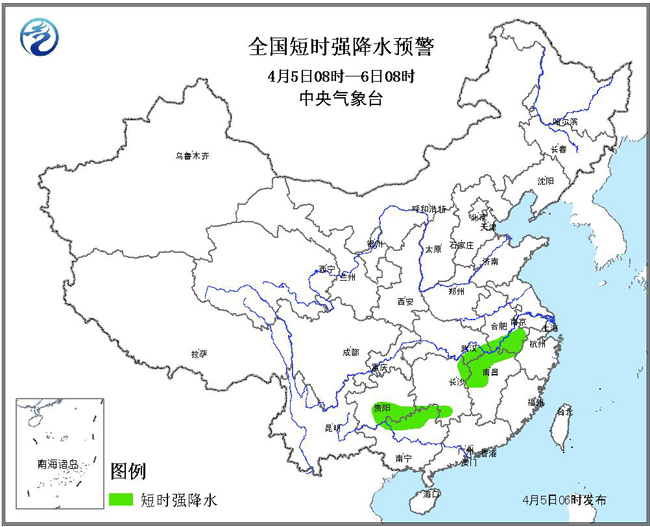
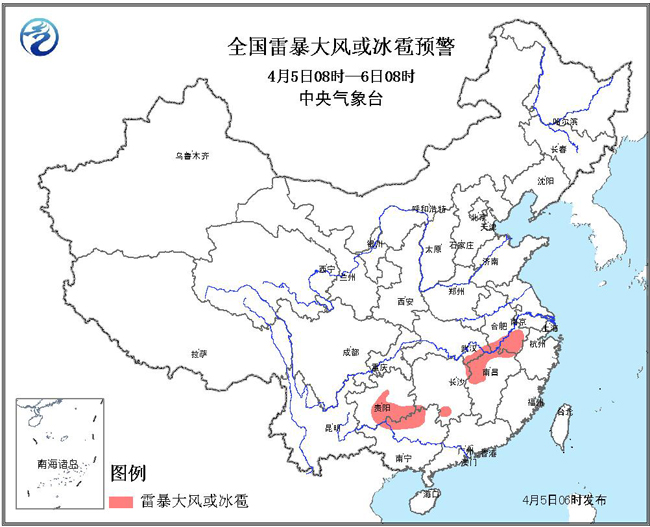
  It is estimated that there will be short-term heavy precipitation in some areas of southern Anhui, northwestern Jiangxi, southeastern Hubei, northeastern and southwestern Hunan, southern Guizhou and northwestern Guangxi from 08: 00 on April 5 to 08: 00 on April 6. It is estimated that the hourly rainfall intensity can reach 30-50 mm, and the local area will reach more than 50 mm. There are hail or thunderstorms and strong winds in parts of southern Anhui, southeastern Hubei, northwestern Jiangxi, southern Hunan, south-central Guizhou and northwestern Guangxi.


    Defense guide:


    1. The government and relevant departments shall, in accordance with their duties, prepare for short-term rainstorm prevention, lightning protection and gale prevention, and the meteorological department shall prepare for artificial hail suppression;


    2. Outdoor pedestrians and staff should reduce outdoor activities and pay attention to stay away from structures such as scaffolding billboards;


    3. Drive poultry and livestock into places with roofs, and close doors and windows to reinforce sheds;


    4. The water operations in relevant waters and passing ships shall take active measures such as returning to Hong Kong to avoid or detour navigation, pay attention to covering building materials at the construction site, and properly arrange outdoor items susceptible to heavy rain, wind and hail;


    5. Check the drainage system of cities, farmland and fish ponds, and prepare for drainage and defense against disasters such as mountain torrents, landslides and mudslides.  


  Typhoon blue warning


  The Central Meteorological Observatory issued a typhoon blue warning at 06: 00 on April 5:


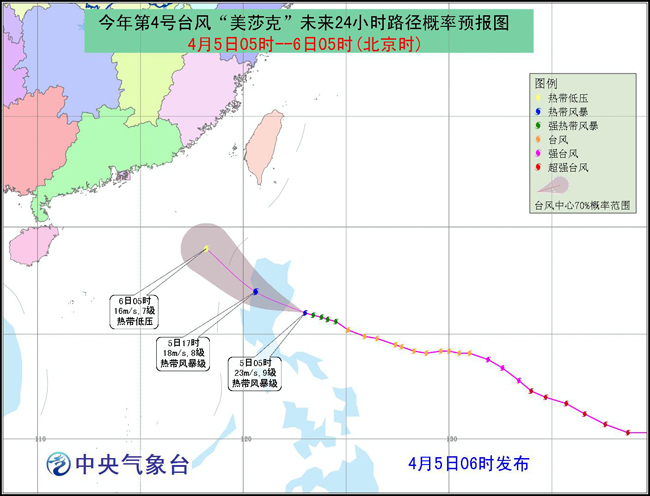
  This year’s No.4 typhoon "Mesak" (English name: Maysak;; Name source: Cambodia; Meaning of the name: a tree) was formed in the Pacific Northwest on March 28th, strengthened to super typhoon level on March 31st, and then weakened continuously. Today (5th) at 5 o’clock in the morning, its center is located on the northwest Pacific Ocean about 270 kilometers north-east of Manila, Philippines, which is 16.0 degrees north latitude and 123.0 degrees east longitude. The maximum wind force near the center is 9 (tropical storm level, 23 m/s), the lowest pressure in the center is 988 hectopascals, and the radius of the 7-level wind circle is 50-200 kilometers.


  It is estimated that "Mesak" will move to the northwest at a speed of 20-25 kilometers per hour, and its intensity will gradually weaken. It will land in the coastal area of northeastern Luzon Island in the Philippines (8-9, 20-23 m/s), then pass through the northern part of Luzon Island, and will move into the northeastern South China Sea (7-8, 16-20 m/s) around the evening of the 5th.


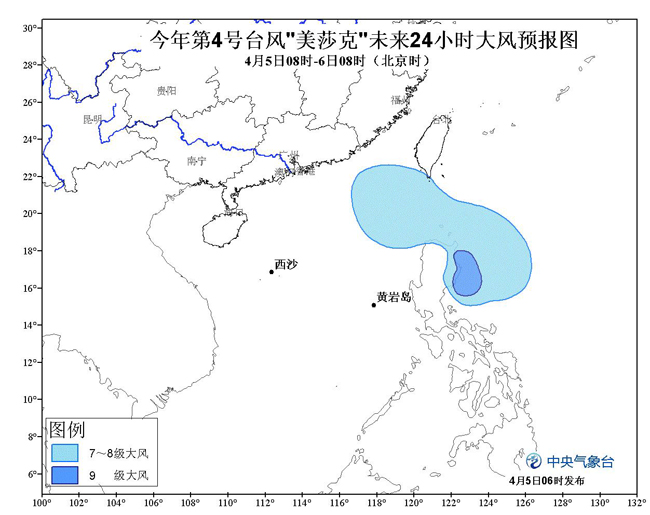
  From 08: 00 on the 5th to 08: 00 on the 6th, there will be strong winds of magnitude 7-8 in bashi channel and the northeastern part of the South China Sea, with gusts of magnitude 9 in some sea areas.


  Defense guide:


  1. The government and relevant departments shall, in accordance with their duties, do a good job in typhoon prevention and emergency rescue;


  2. Take active measures for water operations and passing ships in relevant waters, strengthen port facilities, and prevent ships from anchoring, grounding and collision.


  (Editor: Su Jessie)

Seven experts called for paying attention to supporting the development of rice oil industry and improving the self-sufficiency rate of edible oil in China

  Harbin, China Economic Net, July 6 (Reporter Wu Xuan) One of the reasons that have restricted the development of rice oil in China for many years is that rice bran is easy to rancidity and difficult to preserve. Now this technical bottleneck has made a new breakthrough. Yihai Kerry, the parent company of Arowana, has created a brand-new rice oil production model of decentralized preservation, centralized collection and centralized refining. "The remaining problem now is to study the policies and measures to support the development of rice bran oil industry." Wang Ruiyuan, chief expert of China Cereals and Oils Association and president of the Oil Branch of China Cereals and Oils Association, called on the "Seminar on the Integrated Development of Rice Circular Economy Industry Chain and Rice Oil Industry" held in Harbin on July 6, hoping that the state would pay more attention to the rice oil industry and give support in policies, funds and taxes, so as to accelerate the development of rice oil industry and improve the self-sufficiency rate of edible oil in China. Experts attending the meeting actively put forward suggestions and suggestions on exploring a new model of rice circular economy industrial chain, strengthening the implementation of China’s rice oil series standards, and improving rice oil production technology.

  Rice oil, with its balanced nutritional proportion, has the reputation of "golden rice" and is a healthy edible oil recommended by the World Health Organization. In Japan, a big rice producer, the utilization rate of rice bran is nearly 100%. Rice oil has become the designated oil for nutritious lunches of primary and secondary school students in Japan. The production of rice oil in China began in the 1950s, and in the 1970s and 1980s, the work of increasing oil production, represented by the promotion of rice bran and corn germ oil extraction, was carried out nationwide, with remarkable results. However, due to various reasons, the utilization rate of rice bran in China is less than 20%. Most rice bran is used as feed, or even discarded as waste, which is a sad waste of resources. The data shows that the self-sufficiency rate of edible oil in China in 2015-2016 was 32.3%.

  Experts believe that as the largest country in rice production and consumption, the nutritional value and resource benefit of rice bran by-products in China have not been fully exerted. If the rice bran, a by-product of rice with an annual output of 200 million tons in China, is used to extract oil, it is equivalent to about 13 million tons of soybean oil, which is equivalent to saving 110 million mu of soybean cultivated land for the country, which will greatly improve the self-sufficiency rate of edible oil in China. Developing rice oil industry is one of the effective ways to improve the self-sufficiency rate of edible oil in China without competing with fertile land. Experts attending the meeting said that actively developing rice oil industry in China is a necessary move for the supply-side structural reform of edible oil processing industry.

  At present, there are three main reasons that restrict the development of rice oil in China: first, the rice processing enterprises in China are small and scattered, and it is difficult to concentrate rice bran; Second, rice bran is prone to rancidity and deterioration, and the preservation technology is not easy to solve; Third, the policies and measures to support the development of rice oil industry are not strong enough.

  At present, the technical bottleneck has been broken. According to reports, Yihai Kerry, the parent company of Arowana, has created a brand-new production mode of rice oil with decentralized preservation, centralized extraction and centralized refining. It has used a series of advanced production technologies such as 6-hour expansion preservation, low-temperature extraction and internationally advanced green enzymatic degumming, so that natural cereal active nutrients such as oryzanol, vitamins and sterols can be retained to the greatest extent.

  Rice bran oil production is an important link of rice circular economy in Yihai Kerry. Since entering the field of rice processing in 2006, Yihai Kerry has started to research and develop a new model of comprehensive utilization of rice. In the past ten years, the accumulated investment has reached several billion yuan, and gradually built a new circular industry model of "order planting-intensive processing-product brand-name-making-comprehensive utilization of by-products-high-tech product research and development". Through the order base, the purity of rice varieties and the quality of arowana rice are guaranteed; At the same time, independently research and develop rice bran preservation technology to improve the yield and quality of arowana rice oil. Fatty acids, rice bran wax, rice bran fat, oryzanol, ferulic acid and other high value-added products extracted from rice bran oil by-products and rice bran meal are widely used in food special oils, grease chemicals, cosmetics and other industries; At the same time, rice husk combustion was realized to generate electricity, and activated carbon and white carbon were prepared from rice husk ash. At present, the rice husk silica produced by Yihai Kerry has achieved cross-industry cooperation with tire production giants and is being popularized and applied worldwide.

  Yihai Kerry’s rice circular economy model has truly realized the transformation from the traditional extensive rice processing model to the "eat dry and squeeze clean" processing model with intensive processing and high-efficiency and energy-saving utilization of by-products, which has increased farmers’ rice planting income and increased the added value of rice products, and realized the integration of order agriculture, intensive processing of agricultural products, brand product sales and service. Nowadays, the utilization rate of rice bran in Yihai Kerry rice circular economy model reaches 60-70%, which is much higher than the average ratio of rice bran utilization rate of less than 20% in the whole industry.

  Jiang Yuanrong, a researcher at Fengyi (Shanghai) Biotechnology R&D Center Co., Ltd., said that this model can fully develop and utilize the economic value of rice. If it can be replicated and promoted throughout the country, its economic and social benefits will be considerable.

  In April 2017, Yihai (Jiamusi) Cereals and Oils Industry Co., Ltd., a subsidiary of Yihai Kerry, was officially approved by the National Development and Reform Commission as the "National Pilot Unit for Standardization of Rice Processing Circular Economy", which is the only pilot enterprise in the rice processing industry in China, marking that this global leading rice circular economy model has been incorporated into the national green development plan. "Perfecting and popularizing it will be beneficial to the sustainable development of rice processing and rice oil industry in China." Zhang Guifeng, chairman of China Cereals and Oils Society, fully affirmed Yihai Kerry’s active exploration and practice in the industrial chain mode of rice circular economy.

  On October 25th, 2016, at the 3rd ICRBO- International Rice Oil Conference held in Tokyo, Japan, Arowana rice oil from China won unanimous praise from oil experts from China, Japan, India, Thailand and Vietnam, and won the only "International Rice Oil Quality Award" selected by the Conference. The award indicates that China’s independently innovated rice oil production technology has completely surpassed Japanese and advanced the international level.

  The 13th Five-Year Development Plan of Grain and Oil Processing Industry formulated by the State Grain Administration proposes to "actively develop rice bran oil", and to "achieve the utilization rate of by-products such as rice bran above 50%" by 2020, and cultivate a number of leading enterprises in the integration of grain and oil processing industry. At this stage, increasing policy support has become a booster to accelerate the integration and development of rice, oil and three industries in China.

  The meeting was jointly sponsored by the Oil Branch of China Cereals and Oils Association, the Technical Committee of Oils and Oils of National Cereals and Oils Standardization Technical Committee, and undertaken by Fengyi (Shanghai) Biotechnology R&D Center Co., Ltd. The meeting aims to further promote the development of China’s rice oil industry and deepen the transformation and upgrading of China’s grain processing industry. 

Regenerative Medicine Breakthrough China Scientists Induce Human totipotent Stem Cells.

  Recently, researchers from China Academy of Sciences, Shenzhen Huada Institute of Life Sciences and other institutions have cultivated human pluripotent stem cells in a state similar to that of fertilized eggs developing for three days through somatic cell induction. This is the "youngest" human cell cultured in vitro in the world at present, and it is another subversive breakthrough in the field of regenerative medicine after scientists successfully induced human pluripotent stem cells. Related research results were published in the international academic journal Nature in the early morning of March 22nd, Beijing time.

  It is understood that researchers have developed a non-transgenic, fast and controllable "cocktail" cell reprogramming method, which can transform human pluripotent stem cells into totipotent 8-cell embryonic-like cells, that is, totipotent stem cells equivalent to the three-day development of fertilized eggs. This achievement will help to realize the in vitro regeneration of human organs in the future, and it is of great significance to solve the problems of organ shortage, allograft and xenotransplantation rejection.

  In 2012, the Nobel Prize in Physiology or Medicine was awarded to shinya yamanaka, a Japanese scientist who successfully induced mature somatic cells into pluripotent stem cells in blastocyst stage. The cells in human blastocyst stage are fertilized eggs developing 5-mdash; In the state of 6 days, its ability to further develop is limited.

  However, this study has made a big step forward in this field, and for the first time, embryonic cells with fertilized eggs divided for only 3 days were obtained. In the early stage of fertilized egg development, great changes have taken place every day, and it is these 2-mdash; In 3 days, scientists obtained human 8-cell embryonic-like totipotent stem cells through in vitro induction for the first time. This is the "youngest" human cell induced in vitro so far, and it has very strong development potential. This study will also help to unlock the key to the early development of human embryos.

  According to reports, these totipotent 8-cell embryonic-like cells reconstructed the embryonic state of fertilized eggs after only three times of division. Compared with pluripotent stem cells in the past, these cells can differentiate into placental tissues and may develop into more mature body tissues.

  "This progress is also a model of the combination of regenerative medicine and single cell sequencing technology." Dr. Liu Longqi from Shenzhen Huada Institute of Life Sciences, one of the authors of the paper, said, "The efficient identification and mechanism analysis of cells or tissues obtained by stem cell technology in vitro or in vivo will greatly accelerate the development of regenerative medicine."

  This is the first time that researchers have "transformed" human pluripotent stem cells into pluripotent embryonic cells in a real sense, so that people can reverse the "adult" version of cells into "infant" versions with more possibilities. At the same time, because the totipotent cells obtained this time are closer to the original state of early embryos, if they are used in regenerative medicine, the cultivated organs will be closer to the state of real organs, which is more conducive to transplantation.

  This breakthrough is due to the progress of single cell sequencing technology. In the past, researchers may have to process and culture thousands of cells, and the probability of success is less than 10%. Nowadays, based on the single-cell library sequencing platform (DNBelab C4) independently developed by Huada University, combined with the DNBSEQ sequencing technology created by Huada Zhizhi, scientists can conduct multidimensional single-cell analysis with high sensitivity and accuracy, quickly obtain cells with important development potential, and study the development direction of these cells.

  In this study, the research team also classified the induced pluripotent stem cells and injected them into mice for further development, and then used the single cell sequencing technology of Huada to conduct large-scale cell map analysis. Finally, the researchers confirmed that the experimental totipotent stem cells were highly similar to human 8-cell embryonic cells, which proved the totipotency of the cells. This provides a scientific basis for organ culture using patients’ own cells in the future and for organ transplantation and replacement.

  The research was led by China Academy of Sciences and Shenzhen Huada Institute of Life Sciences, with the participation of several research teams including Cambridge University, Jilin University and rajshahi University. This study has passed the ethical review and strictly followed the corresponding laws and regulations and ethical standards.

Pharmaceutical Business Advisor AstraZeneca Chloe Wang: Writing the Next Growth Decade with Ecosphere and Digitalization

    The column "Insight into New Trends and New Possibilities of Pharmacy" is a special program "Pharmacy Consultation" for the seventh anniversary of Ali Health Pharmacy jointly produced by Ali Health and Cyberblue. The purpose of this paper is to explore the new trend of medical and health industry in the new era from the perspective of pharmaceutical companies’ first site, and to discuss how pharmaceutical companies and Internet medical platforms can jointly build an ecology to provide users with more comprehensive, professional and convenient new ways of health services under the changing industry and around the changing needs of users.

    Today, we will review AstraZeneca’s innovative practice of deepening the China market for 30 years, and discuss the "entrepreneurial history" of this multinational pharmaceutical company in China from two dimensions of "digitalization" and "ecological circle".

    "Taking patients as the center and technology as the driving force, we will jointly explore the construction of a healthy and innovative ecology. While realizing digital medical care, we will help improve the integrated diagnosis and treatment and the whole course management plan, bringing new ideas for chronic disease management, primary care and multi-scene medical services. This is the fifth year of AstraZeneca’s health cooperation with Ali. In the year, AstraZeneca’s global executive vice president, international business and China President Chloe Wang sent a message to Ali Health.

    Behind this message, on the one hand, AstraZeneca’s positive layout in the digital field, and on the other hand, its interpretation in innovative ecological cooperation. These are the two main ideas that AstraZeneca cultivated in the China market for a long time.

    When talking about AstraZeneca, apart from its important role in tumor, cardiovascular and respiratory treatment, we will also mention AstraZeneca’s attitude of embracing the China market and focusing on the China market: in the past 30 years, AstraZeneca has embarked on its own path from product introduction to overweight manufacturing to the construction of innovative ecology.

    AstraZeneca embraced the China market vigorously, and the China market also gave AstraZeneca a good feedback-for a long time, AstraZeneca’s sales in China were among the best among multinational pharmaceutical companies.

    On the 30th birthday just past, AstraZeneca said that it would continue to "bring in" and "go out" simultaneously, push China’s innovation to the world and continue to embrace the China market.

    "Embrace the China market" is not just a slogan. How did AstraZeneca land? We try to deconstruct from two aspects: "digitalization" and "ecological circle".

    AstraZeneca’s Innovation Ecosphere

    As a leading pharmaceutical company in the world, AstraZeneca’s product innovation has always been at the forefront of the world. Although there are not a few multinational pharmaceutical companies with strong products entering the China market, AstraZeneca is the most outstanding in terms of volume and growth rate.

    Behind this is that AstraZeneca, on the basis of its rich treatment methods, has long been committed to promoting the mutually beneficial integration of global and local innovations in China: identifying the connection points between enterprises and policies and market trends, and the advantages of China’s supply chain, and constantly innovating the upstream and downstream cooperation models.

    In diagnosis, the industry trend of accurate detection should be followed. AstraZeneca and its partners announced the establishment of the MET HER2 Accurate Diagnosis Alliance to jointly build the capabilities in disease prevention and early screening, personalized treatment plan and so on.

    In terms of treatment, with the rise of local innovation in China, AstraZeneca actively explores ways to cooperate with local pharmaceutical companies with an open mind on its own product pipeline array. Last year, AstraZeneca and Unacon started cooperation on oxitinib. As a part of the long-term project of "lung cancer targeted joint scientific research cooperation", AstraZeneca is trying to link the clinical strength of local pharmaceutical companies to better improve the survival and benefit of lung cancer patients in China.

    In disease management, AstraZeneca starts from the scene of field diagnosis and treatment, helps medical institutions to build a bridge between doctors and patients, and provides solutions such as full course management and integrated diagnosis and treatment. AstraZeneca has signed strategic cooperation agreements with a number of medical groups to jointly integrate high-quality resources and strengthen the role of non-public medical care in China’s current medical system.

    From diagnosis to treatment to management, AstraZeneca’s strategic layout and cooperative ecology cover the complete treatment journey of patients.

    In addition to the traditional health industry chain, AstraZeneca is also actively embracing the new format of the health industry.

    In May this year, AstraZeneca and Ali Health jointly built a cardiovascular disease education and rehabilitation platform to provide customized and innovative digital health management services for patients with chronic diseases. Some consumption scenes of chronic diseases have been moved online, and through digital means, patients’ disease cognition and course management efficiency have been improved.

    "By building the" Troika "of innovative ecosystems such as China Smart Health Innovation Center (CCiC), International Life Science Innovation Park (iCampus) and AstraZeneca Zhongjin Medical Industry Fund (AZ-CICC Fund), AstraZeneca has joined hands with local pharmaceutical innovation forces in China to continuously and deeply build an international healthy innovation ecosystem." Zhu Lixuan, vice president of AstraZeneca China, head of the Digitalization and Business Innovation Department and the Business Strategy and Operational Excellence Department, explained the concept of the ecosphere.

    She said that AstraZeneca very much hopes to find an ecosystem partner who is also patient-centered and can complement each other’s business. The advantages of AstraZeneca in the field of medicine will be combined with excellent enterprises in the fields of equipment, special medical food, mental health and sports to achieve cooperation covering many aspects of the whole course management.

    Previously, foreign pharmaceutical companies relied on advanced products to meet the health needs of their stocks in the China market. Nowadays, the growth of the pharmaceutical industry needs everyone to make the cake in the market bigger together. The creation of AstraZeneca innovation ecosystem is the process of making the cake bigger with partners.

    Digitally open up the whole course management

    If the "ecological circle" is to improve the service experience of patients in the whole diagnosis and treatment process, then "digitalization" is a powerful tool to improve the medical and health service experience.

    The combination of "smart medical care" and "patient-centered" requires all parties in the medical system to cooperate through digital tools, provide continuous, convenient and high-quality services for patients, and track, record and guide each stage of the course.

    In this regard, AstraZeneca’s strategy is to focus on subdividing the treatment field, explore a set of landing models, and copy them to other fields.

    In terms of business, AstraZeneca supports associations, hospitals and experts to launch an innovative diagnosis and treatment system integrating screening, diagnosis, treatment and management; A digital management platform has been established in many fields, such as tumor, cardiovascular disease and chronic disease, so that every link of standardized treatment can be standardized, and standardized diagnosis and treatment data can be accumulated through standardized electronic medical records and quality control management in diagnosis and treatment.

    Faced with a series of problems such as uneven supply of medical resources in the low-end market and complicated process of patient diagnosis and treatment, AstraZeneca has applied for digital solutions such as remote consultation, multidisciplinary diagnosis and treatment (MDT) and distance academic training and education, and is committed to improving the quality of diagnosis and treatment in various places.

    In terms of channels, AstraZeneca also spared no effort to give full play to the advantages of digitalization.

    Grass-roots business has been difficult for many pharmaceutical companies to cover because of its wide distribution and low service efficiency. This is what AstraZeneca has been trying to overcome since it entered the China market. AstraZeneca has cooperated with many local e-commerce companies and Internet medical platforms, such as Ali Health, to create an online and offline integrated health service scene, which improves the accessibility of medical care and patient medication. In addition, AstraZeneca has specially built a grassroots business team to actively improve the medical service experience of patients in third-and fourth-tier cities.

    The innovation of digital diagnosis and treatment (service) and the improvement of infrastructure in distribution channels (tools) make AstraZeneca closer and closer to its goal in the grassroots market.

    In addition, based on the established standardized treatment database, AstraZeneca is also exploring the empowerment of product research and conducting comprehensive digital medical exploration and research.

    At the same time, AstraZeneca is also using some cutting-edge digital tools to empower the whole process.

    Shenrui Medical, a participating enterprise of AstraZeneca Zhongjin Medical Industry Fund, is one of the pioneers in the field of AI medical care in China. Its Dr.Wise AI medical auxiliary diagnosis system uses international cutting-edge technology to make artificial intelligence medical image diagnosis reach the advanced level, and it is in the forefront of the industry in the accurate diagnosis of diseases in various systems, which can provide clinical suggestions for doctors to make further diagnosis and treatment decisions. At present, the system is widely used in decision-making and follow-up of early screening of lung cancer, early screening of breast cancer and auxiliary assessment of stroke, which effectively helps to improve the efficiency of doctors’ diagnosis and treatment and reduce the rate of misdiagnosis and missed diagnosis.

    Digitalization is not a concept, but for "usefulness".

    "Realizing data insight and closed loop at each key node is the key to the success of digital transformation of pharmaceutical companies. But we can’t digitize for the sake of digitization. All digital transformations must be patient-centered, empower doctors and patients through digital innovation, improve the efficiency of disease management, and ultimately benefit patients. " Zhu Lixuan said this.

    Multinational pharmaceutical companies start businesses in China.

    Health is an eternal demand. No matter how the external environment changes, consumers are willing to invest in high-quality health needs.

    In the field of health consumption, there are both commodity consumption and service consumption, such as online consultation and telemedicine; It not only integrates cutting-edge scientific and technological innovations, but also integrates fine and intimate health guidance. Consumer demand is diversified, personalized and multi-level, and the update and upgrade speed is faster.

    Under the diversified consumer demand, AstraZeneca is exploring how to match the needs of China patients with more drugs and solutions.

    At first, AstraZeneca introduced abundant therapeutic tools to China. Since then, AstraZeneca has continued to expand the localization process in the supply chain to improve the accessibility of drugs at lower production costs.

    Nowadays, when the demand for health consumption is more and more diversified, from treatment to service, from effectiveness to accessibility, from the north to the low-end market, from simply eliminating illness to improving the whole process experience … AstraZeneca meets these diversified needs one by one. The process of finding the demand and satisfying it is a process of starting a business.

    Talking about AstraZeneca’s future layout of China market, Zhu Lizuan shared: "On the basis of the continuous improvement of agglomeration effect and mode maturity, the’ Troika’ of innovation centers, innovation parks and funds is expected to further strengthen their mutual coupling and driving operation modes and help more local innovation achievements to land. In the future, AstraZeneca will also promote more innovative models, innovative enterprises and innovative achievements in China to the world stage by building bridges to the sea, and vigorously promote the global layout and development of China enterprises. " Zhu Lixuan mentioned.

Keep enough cars and prepare enough people to go all out to ensure the express delivery "Spring Festival travel rush"

  CCTV News:Every year before the Spring Festival, it is the peak season for all kinds of express delivery. Since Spring Festival travel rush started on January 7th, the daily postal express delivery volume has been over 300 million pieces, with a peak of over 400 million pieces. What changes have been made to the express delivery capacity that will be tight in previous years? Can the express delivery business be guaranteed during the holidays? Is the way home by express delivery smooth?

  At 6: 30 in the morning, at this express outlet in Zhongguancun, the person in charge, Lei Liping, simply said a few words, and the express buddy immediately threw himself into the sorting work.

  As the nearest express terminal service point to customers, from 4: 00 in the morning, there are trucks coming into the field one after another, and express parcels sent from all over the country to nearby areas are pulled from the transit point. The express parcels waiting to be sorted and delivered quickly piled up a hill.

  "hurry up! Hurry up! " This is the word that reporters hear the most frequently at the scene. Lei Liping told reporters that near the Spring Festival, the peak of express delivery has been ushered in recent days. Because most of them are fresh food, gifts and other new year’s goods, in order to ensure the timeliness, the express delivered from all over the country in the morning should be delivered to customers before noon. Nearly 50 courier brothers in this outlet have to arrive at their posts before 6: 30 in the morning, and breakfast can only be solved.

  Less than 8 o’clock, the five express parcels sent in the morning have been sorted.

  Go all out to ensure the express delivery "Spring Festival travel rush", the grass-roots outlets at the end of delivery operate efficiently, and the circulation at the end is smooth. Then, what is the transition in express delivery with a wider business scope?

  The reporter saw in a courier transfer near the Capital Airport that dozens of unloading ports were full of trucks. On the other hand, there are long queues of vehicles waiting for unloading.

  Handling 600,000 peak packages per day is definitely not possible by manpower alone. The reporter saw at the scene that the automatic sorting equipment helped a lot. After unloading, these parcels were transported to the automatic sorting machine, and more than 600 sorting ports could be automatically divided into different parcel bags according to the area codes on the face sheet.

  Save enough cars and people. In order to cope with the peak of express delivery during the Spring Festival, recently, many express delivery companies have proposed "no fighting during the Spring Festival" to ensure the smooth flow of express logistics.

  In Beijing Xinfadi Fruit Wholesale Market, Wei Dongwen, who is in charge of contacting the truck service for merchants, asked about the shipment of merchants and contacted the truck by phone.

  Wei Dongwen told reporters that people have been going home for the New Year these days, but they have also left enough manpower to ensure the delivery needs of customers. During the Spring Festival, there are still many courier brothers who are ready to stick to their posts to ensure that the courier service during the festival is not interrupted.

  Shi Jianting and Zhang Huanrong, couples from Linfen, Shanxi, have stayed at the delivery line for four consecutive Spring Festival. The couple planned that after the 14th day of the first month, the list was running out, and they would go home at the wrong peak.

  The reporter learned in the interview that a number of measures have been introduced in various places to actively respond to the express delivery demand during the holiday season. Some express delivery companies start the "night delivery" mode, extend the delivery time at night, and give priority to timely delivery of drugs, epidemic prevention materials and food. Jiangsu issued 35 million yuan of government subsidies for the postal express delivery industry to stabilize and return to work, helping the postal express delivery industry to accelerate its recovery. In Luzhou, Sichuan, the bus driver undertakes the task of delivering the express delivery. After receiving the express delivery from the postal transport vehicle, the bus driver sorts and delivers the express delivery to the Jintong Post Express Station in each village to get through the "last mile" of the parcel entering the village.